VMPL
Mumbai (Maharashtra) [India], November 2: When the Government e-Marketplace (GeM) moved public purchasing in India onto a single digital platform, it gave government buyers something most private companies still lack: one transparent, rule-bound environment where every tender, bid and approval leaves a record. Inside many enterprises, procurement still runs on long email threads, spreadsheets saved as "Quote_v3_FINAL", missing vendor documents and approvals that sit unattended for days.
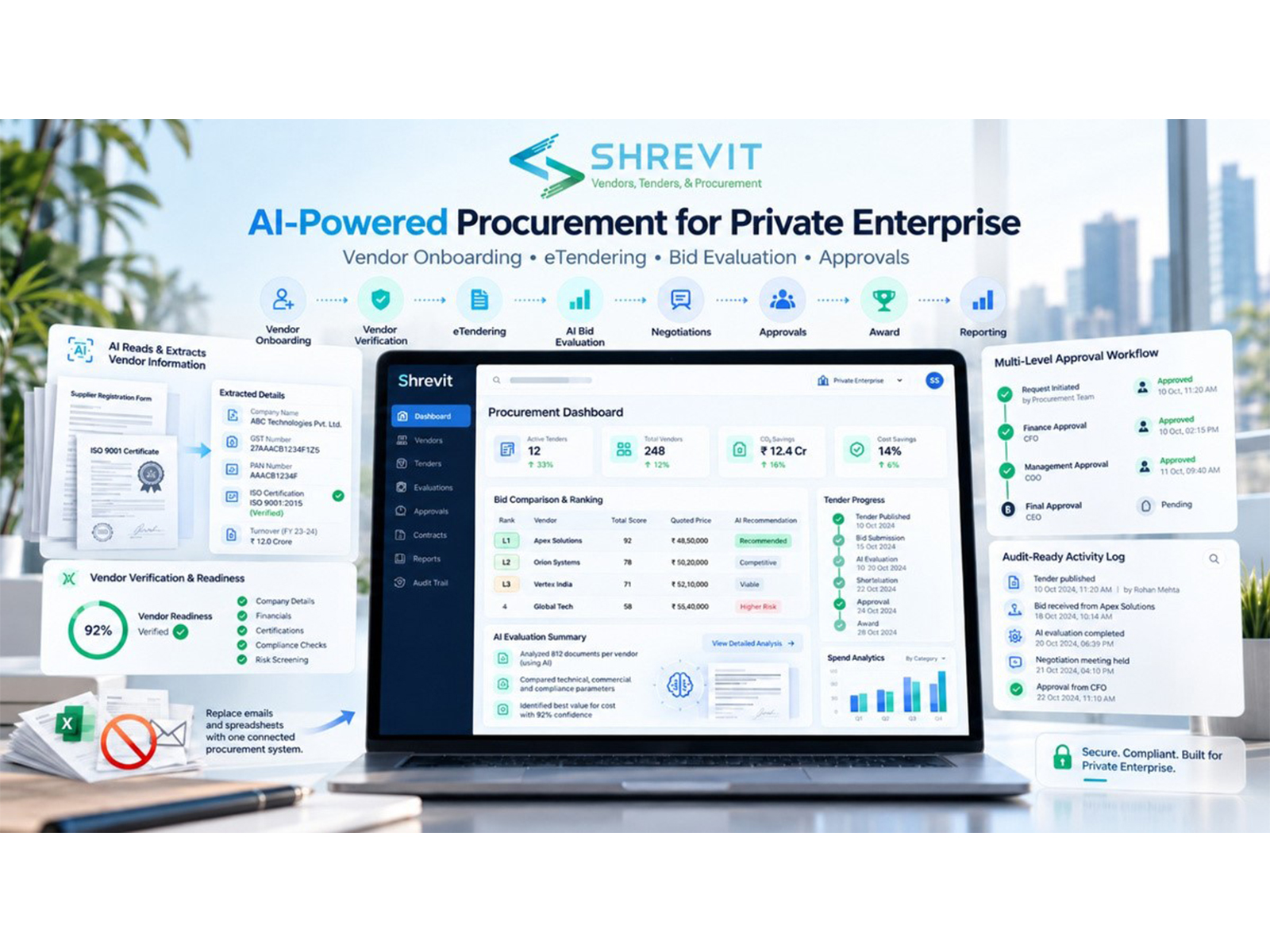
Shrevit, an AI-powered procurement platform from Mumbai-headquartered NWDCo Software Solutions LLP, is built to close that gap. It brings vendor onboarding, AI vendor verification, digital eTendering, bid evaluation, negotiations, approvals and reporting into one connected system, with the ambition of becoming the defining platform for private enterprise procurement.
One workflow, from onboarding to award
Shrevit organises the procurement lifecycle into eight connected stages: onboard, verify, tender, evaluate, negotiate, approve, award and report. Vendors, tenders and decisions sit in the same workspace, giving procurement heads, finance teams and CFOs a single source of truth instead of a trail of disconnected files.
The platform can be configured around an organisation's existing procurement process and approval hierarchy, and role-based permissions let multiple departments and locations work on it together. It is aimed at sectors including real estate, hospitality, manufacturing, healthcare, education and other large enterprises and conglomerates.
AI that verifies vendors and ranks bids
Vendor onboarding, typically one of the slowest steps in enterprise purchasing, is largely automated. Shrevit's AI reads documents such as GST certificates as they are uploaded, extracts details including the legal entity name, GSTIN, PAN and business category, and validates bank account ownership. Automated vendor verification then checks identity and registration, tax and statutory compliance, financial health, bankruptcy and foreign directorship, producing a supplier readiness score before a vendor is invited to bid.
At the evaluation stage, Shrevit's AI bid analysis compares technical and commercial submissions against weightages set by the buyer, such as a 60:40 split between quality and price. Vendors are ranked L1, L2 and L3, even when some have submitted only partial bids, and deviations are flagged for review before an award is made. Negotiation tools, including live reverse auctions, support competitive sourcing. The AI recommends; people decide.
"Having spent 25 years building technology solutions for enterprises, we understand that the real value of innovation lies in solving complex business challenges with simplicity, transparency, and trust. With Shrevit AI, we are bringing this philosophy to procurement by combining AI-powered vendor verification, intelligent analysis, and digital tendering to help organisations make more informed decisions and build greater confidence in their procurement processes," said Nishir Gordhandas, Founder & CEO, NWDCo Software Solutions LLP.
Built for compliance and audit teams
For audit and compliance functions, the strongest argument may be traceability. Every action is captured in a time-stamped activity log: when a tender was published and to how many verified vendors, when sealed bids were opened and by which committee, when scoring weights were locked, when an auction closed and who approved the award.
Multi-level approvals follow role-based routing in which value thresholds decide who signs off, from procurement to finance, the CFO and the managing director. Decisions and comments stay on record, audit-ready reports can be exported on demand, and real-time dashboards track spend under management, procurement cycle times and the share of verified vendors.
Enterprise-grade security and integrations
Procurement data is commercially sensitive, and Shrevit is designed accordingly. NWDCo is ISO/IEC 27001:2022 certified and partners with AWS, Microsoft Azure, Google Cloud for its deployment, and each Shrevit installation runs on its own private cloud environment, with controlled access and human-in-the-loop guardrails.
The platform integrates with the systems enterprises already run, including SAP S/4HANA, Oracle, Microsoft Dynamics and Zoho, along with Salesforce, GEP, single sign-on, ServiceNow, Power BI and payment gateways such as Razorpay. According to the company, implementation can be completed within days, subject to client inputs and approvals.
Twenty-five years in the making
Shrevit is part of the technology journey of NWDCo Software Solutions LLP, founded in Mumbai in 2001 by brothers Nishir Gordhandas and Maulik Gordhandas. Over 25 years, NWDCo has evolved into an enterprise technology consulting and digital transformation company, with offices in Mumbai, Dubai and Hong Kong.
NWDCo’s existing client relationships include some of the largest organisations and conglomerates spread across India, Dubai and beyond. These relationships reflect NWDCo’s broader enterprise technology experience and are not presented as claims that these organisations use Shrevit.
For the founders, Shrevit represents an opportunity to apply that experience to eTendering and procurement—a business function where consistent processes, reliable information and accountable decisions are important.
A GeM moment for the private sector
As boards place greater weight on governance, procurement is moving from a back-office task to a strategic function, and CFOs are expected to show that every rupee of spend can withstand scrutiny. Shrevit's wager is that private enterprises are ready for the structured, transparent and auditable buying environment that government procurement adopted years ago, and that an India-built platform can deliver it to companies at home and abroad.
For procurement leaders weighing that shift, the pitch is simple: fewer spreadsheets, faster decisions, and a record that holds up when the auditors arrive.
(ADVERTORIAL DISCLAIMER: The above press release has been provided by VMPL. ANI will not be responsible in any way for the content of the same.)